

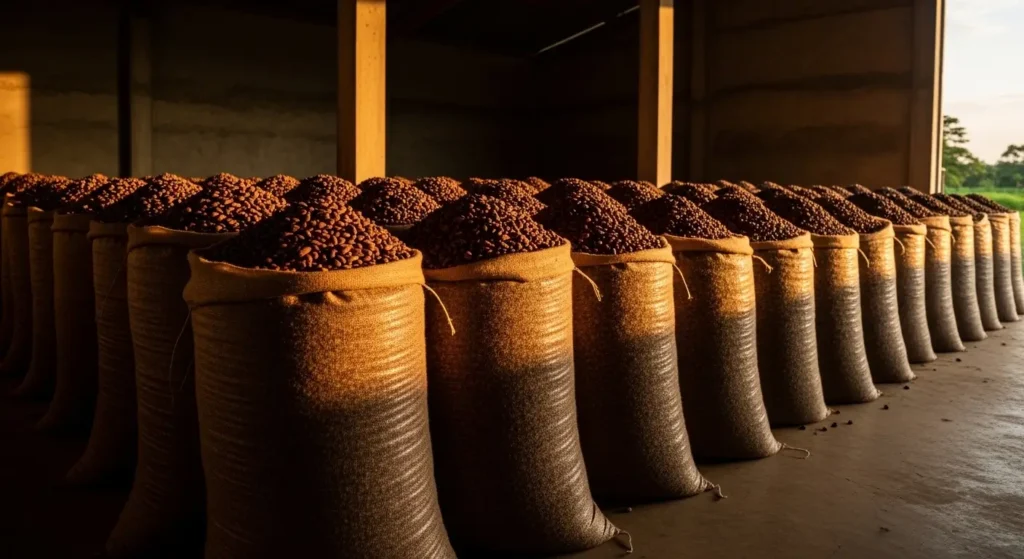
Who Really Pays the Price
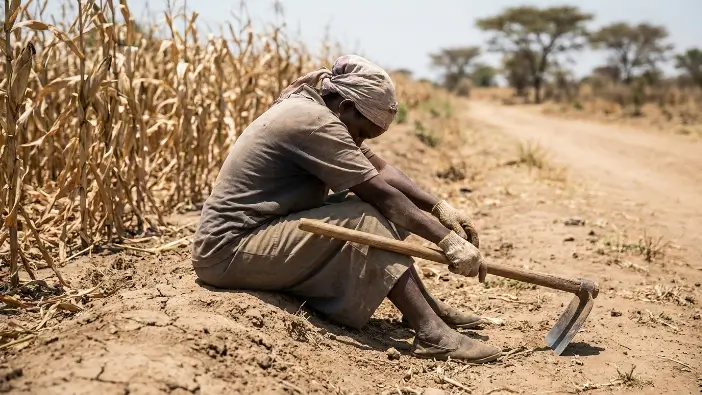
Manu Yaw Fofie was born into cocoa farming in Ghana. The land was his inheritance passed down through his family, the source of everything. In the years when cocoa prices were good, that land produced 300 bags a season. In 2025 it produced 50.
The trees are aging. The climate has shifted. The rains are unreliable. And in February 2026, the government cut the price it pays farmers for their beans by 28.6 percent while many farmers like Fofie had not been paid at all for beans delivered since November 2025.
Somewhere in a supermarket in Brussels or London or New York, a chocolate bar sits on a shelf. The cocoa in that bar almost certainly came from West Africa. Ghana and Ivory Coast together produce 60 percent of the world’s cocoa supply. The farmers who grew it are still waiting to be paid.
That is the cocoa price collapse Ghana Ivory Coast 2026 story. Not a commodity market story. A food systems justice story. And it starts on a farm.
The Cocoa Price Collapse Ghana Ivory Coast 2026
What the Numbers Actually Mean
In early 2024, cocoa futures hit a record above $12,000 per tonne. Chocolate companies shrank their bar sizes. Supermarkets raised prices. Consumers paid more for less. The news cycle ran stories about the most expensive chocolate in a generation.
By March 2026, those same futures have collapsed to around $3,100 per tonne losing three quarters of their value in less than two years.
When prices were high, the farmers did not fully benefit. West African cocoa farmers receive between 60 and 70 percent of the international price for their beans compared to farmers in Ecuador who capture around 90 percent. The system was extracting value from the source before the price peak even arrived.
When prices collapsed, the farmers absorbed the full damage immediately.
On February 12, 2026, Ghana’s Finance Minister Dr Cassiel Ato Forson announced the farmgate price would be cut from GH¢3,625 to GH¢2,587 per 64-kilogram bag a reduction of nearly 29 percent. For approximately one million smallholder farmers whose entire livelihoods depend on cocoa, the announcement landed on top of an existing crisis. Many had not been paid for beans delivered since November 2025. Outstanding farmer arrears in Ghana had already exceeded GH¢10 billion. There were beans sitting on farms with no buyers in sight.
Ivory Coast moved on March 1, 2026, cutting its mid-crop farmgate price to between 800 and 1,000 CFA francs per kilogram down from 2,800 CFA francs during the main crop. In a country where cocoa bean exports make up 40 percent of total export revenue, that is not a price adjustment. It is a national economic shock transmitted directly to the people with the least capacity to absorb it.
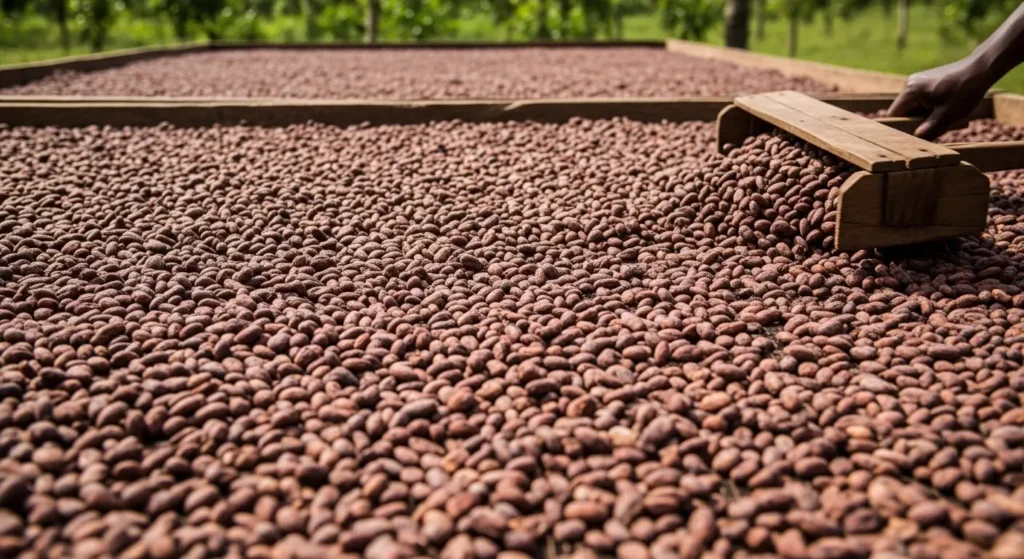
Follow the Bean From the Farm in Ghana to the Shelf in Europe
Follow a cocoa bean from a farm in Ghana to a chocolate shelf in Brussels in 2026 and you find the same thing at every step a value chain that extracts going up and concentrates risk going down. The farmer at the bottom holds the most risk and captures the least value. The brand at the top holds the least risk and captures the most.
The farmer grows the beans. Harvests them. Ferments them. Dries them. Sells them to a Licensed Buying Company at the government-set farmgate price : a price that is set once at the beginning of the season and cannot move with the market. The Buying Company aggregates the beans and sells to COCOBOD Ghana’s cocoa regulator which sells forward contracts to international buyers at prices agreed months in advance.
When the global price was rising, COCOBOD locked in forward contracts at what seemed like strong prices. When the global price collapsed faster than anyone predicted, those contracts became liabilities. COCOBOD had projected 800,000 tonnes for the 2023/24 season but delivered only around 432,000. The undelivered volume was rolled over at below-market rates. That decision alone cost an estimated US$941.58 million in foregone revenue.
The beans that were delivered sat in warehouses. International buyers the chocolate manufacturers in Switzerland, Belgium, the Netherlands became reluctant to take delivery at prices above the collapsing world market rate. ICE cocoa warehouse inventories surged to a six-month high of 2.15 million bags. Cocoa was piling up unsold across West Africa while the world waited for prices to fall further.
Meanwhile the farmer had already harvested. Already delivered. Already spent the income they expected to receive. Already pulled their children out of school or handed their land to illegal sand miners to generate cash as Fofie did, knowing it would make the land infertile.
The bean moved through the chain. The value did not follow it back to where it started.
The Structural Problem That the Cocoa Price Collapse Ghana Ivory Coast 2026 Has Exposed
African universities produce the research. International conferences collect the credit. The same logic runs through the cocoa economy.
Africa grows the raw material. Europe processes it, brands it, markets it and sells it. The margin that turns a cocoa bean into a Lindt bar or a Cadbury finger is captured in Zurich and Birmingham, not in Kumasi or Abidjan.
When cocoa prices were at $12,000 per tonne, European chocolate companies did not pass the full cost to consumers and absorb the loss. They shrank bar sizes a practice so common it has its own name, shrinkflation. They raised prices selectively. They managed their margins. Their investors were protected.
When cocoa prices collapsed to $3,100 per tonne, the mechanism ran in reverse not back to the companies, but directly down to the farmer. The farmgate price was cut by 29 percent. Payments were withheld for months. Arrears accumulated to GH¢10 billion. The farmer with 50 bags and no buyer was told the price had changed.
This is not a market failure. It is a market functioning exactly as designed concentrating value at the processing and branding end of the chain and concentrating risk at the production end. The cocoa price collapse Ghana Ivory Coast 2026 has not created this structure. It has simply made it impossible to look away from.
West African farmers receive 60 to 70 percent of the world price. Ecuador farmers receive 90 percent. That 20 to 30 percentage point gap is not explained by quality or volume. It is explained by who controls the processing infrastructure and who sets the terms of trade.
What Ghana and Ivory Coast Are Doing And What the Crisis Has Forced
The cocoa price collapse Ghana Ivory Coast 2026 has produced one genuine structural development: the two countries are coordinating more closely than at any point in recent memory.
The Ivory Coast-Ghana Cocoa Initiative a bilateral coordination body confirmed that both governments have been working together throughout the crisis on pricing alignment and supply chain management. The farmgate price divergence that briefly opened after Ghana’s February cut created a cross-border smuggling incentive. An estimated 160,000 tonnes of Ghana’s cocoa were illegally exported to Ivory Coast and Togo in the previous season alone. Coordinated pricing between the two countries is the most durable structural defence against the arbitrage pressures that undermine official supply chains on both sides of the border.
Ghana has also begun loosening price control regulations moving toward more flexible farmgate pricing that can adjust with market realities rather than locking in prices at the start of a season and holding them regardless of what the global market does. That change is structural and it matters. A fixed price mechanism in a volatile global market transfers all the downside risk to the farmer. A flexible mechanism one that still protects a floor but adjusts within a range gives the system some capacity to absorb shocks before they reach the farm gate.
The EU Deforestation Regulation, which would require cocoa entering the European Union to be proven deforestation-free with farm-level geographic coordinates and full due diligence documentation, has been postponed by at least a year. For Ghanaian and Ivorian farmers, the delay is breathing space but it is not a reprieve. The regulation will come. And when it does, the farmers who cannot document their land will be cut from the supply chain regardless of the quality of their beans.
The Question the Cocoa Price Collapse Ghana Ivory Coast 2026 Forces Africa to Ask
Mercy Amponsah is a 50-year-old cocoa farmer in Ghana. When the February price cut was announced, she travelled to Accra to protest. She said clearly: accepting the current price means her son will have to drop out of school.
That sentence contains the entire structural problem. A woman who has farmed cocoa for decades, whose labour is the foundation of a global industry worth tens of billions of dollars, is being forced to choose between selling her harvest at a loss and keeping her child in education.
The world’s chocolate supply depends on her continuing to farm. The world’s chocolate industry is not structured to ensure that she can.
The answer is not charity. It is not a price support programme that lasts one season and disappears when the crisis recedes. The answer is what African agricultural economists and policymakers have been naming for thirty years: processing. Value addition. Keeping the transformation from bean to butter to powder to chocolate inside the continent where the beans are grown.
Ghana and Ivory Coast together grow 60 percent of the world’s cocoa. They process a fraction of what they grow. The margin on a chocolate bar versus a raw cocoa bean is the margin that should be building schools in Kumasi and Abidjan not in Switzerland and Birmingham.
The cocoa price collapse Ghana Ivory Coast 2026 will pass. Prices will recover. The next cycle will come. And when it does, if nothing structural has changed, Mercy Amponsah’s granddaughter will be having the same conversation about the same price cut for the same reason.
Unless Africa decides that the bean is not the product. The chocolate is the product. And Africa should be making it.
ABOUT AUTHOR
Jackline Mauta is a Food Systems & Agribusiness Communications Specialist, Journalist, Media & PR professional and Corporate MC with a background in broadcast journalism and public relations. She specializes in documenting and communicating Africa’s food systems and agribusiness sector through articles, media briefs, documentaries and digital storytelling. Her work focuses on translating complex agricultural, market and policy issues into clear narratives that highlight the people, innovations and opportunities shaping the food value chain. Jackline also leads strategic communications and marketing initiatives, helping organizations strengthen their visibility, brand positioning and engagement within the agribusiness ecosystem.