

The Moment After Harvest Is Where Africa Loses the Most Value
Across Africa’s onion-producing regions, harvest is often treated as the end of the agricultural journey. But in reality, it is the beginning of one of the most fragile and financially destructive stages in the entire onion value chain.
In my reporting across food systems, I have consistently observed that the greatest onion post-harvest losses in Africa . They occur immediately after harvest, during handling, sorting, transport and storage. It is at this stage that the effort of an entire season can be reduced in value within days.
In countries such as Kenya, Ethiopia and Senegal, the post-harvest stage reveals a structural weakness in agricultural systems: production is strong, but preservation and market timing systems remain underdeveloped.
Harvesting Under Pressure: The Race Against Spoilage
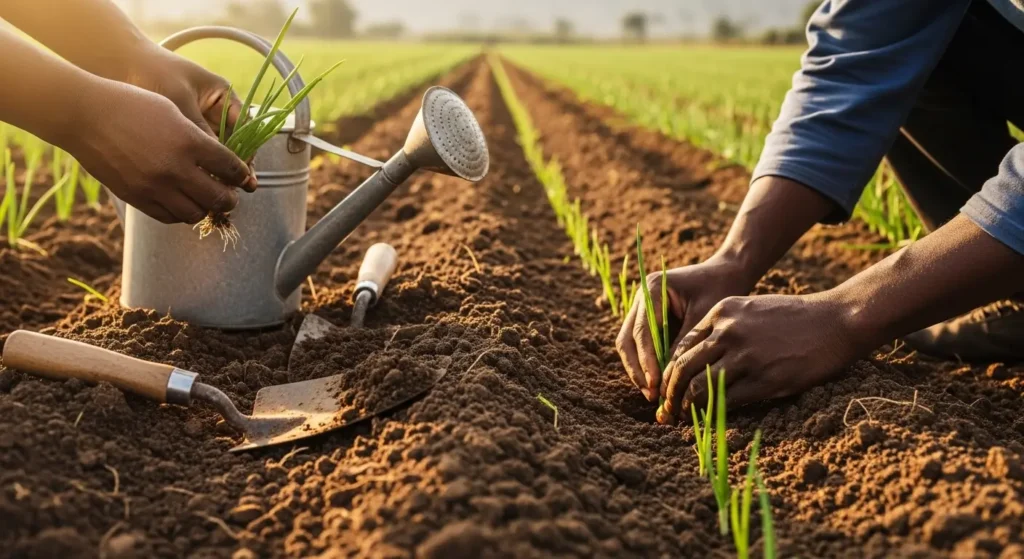
Onion harvesting is a time-sensitive process. Once mature, onions must be carefully lifted from the soil, dried, and prepared for storage or transport. Any delay or improper handling increases the risk of spoilage, bruising or fungal infection.
In many rural farming systems across Africa, harvesting is not only an agricultural activity but also an economic decision made under pressure. Farmers often harvest earlier than ideal because they anticipate market price drops or lack access to proper storage facilities.
This urgency shapes the entire post-harvest system. Instead of optimizing quality, farmers are often forced to prioritize speed. The result is a system where efficiency is sacrificed for survival.
Sorting and Grading: Where Value Is Quietly Decided
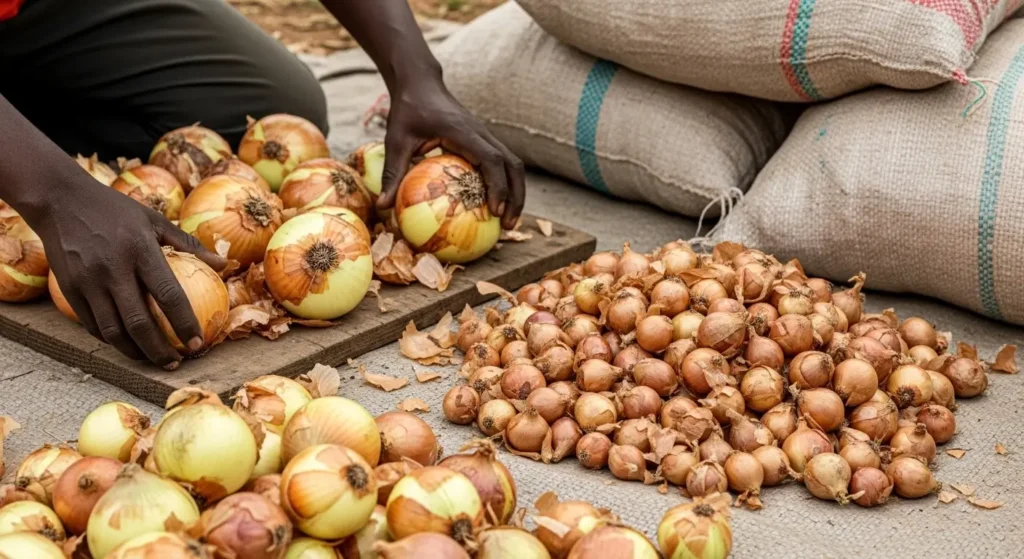
After harvest, onions are typically sorted and graded based on size, quality and appearance. This stage appears technical, but it is one of the most important value-determining processes in the entire chain.
Higher-quality onions are separated for better markets, while damaged or smaller bulbs are sold at lower prices or discarded entirely. In well-structured systems, grading improves market efficiency and pricing accuracy.
However, in many African onion markets, grading systems are informal or inconsistent. This leads to uneven pricing and reduces the ability of farmers to fully capture value from their production.
What appears as a simple sorting process is, in reality, a second layer of economic filtering.
Storage Infrastructure: The Weakest Link in the Chain
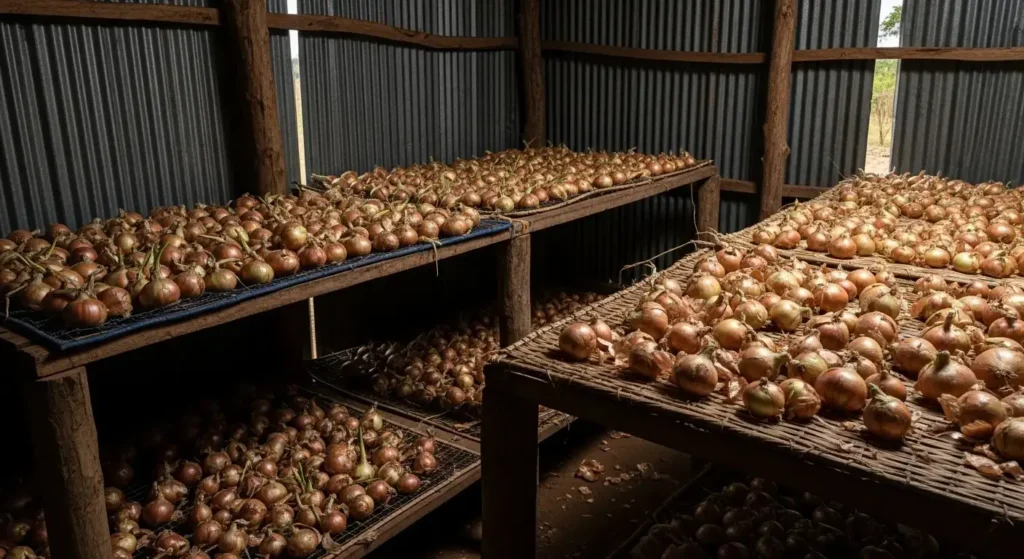
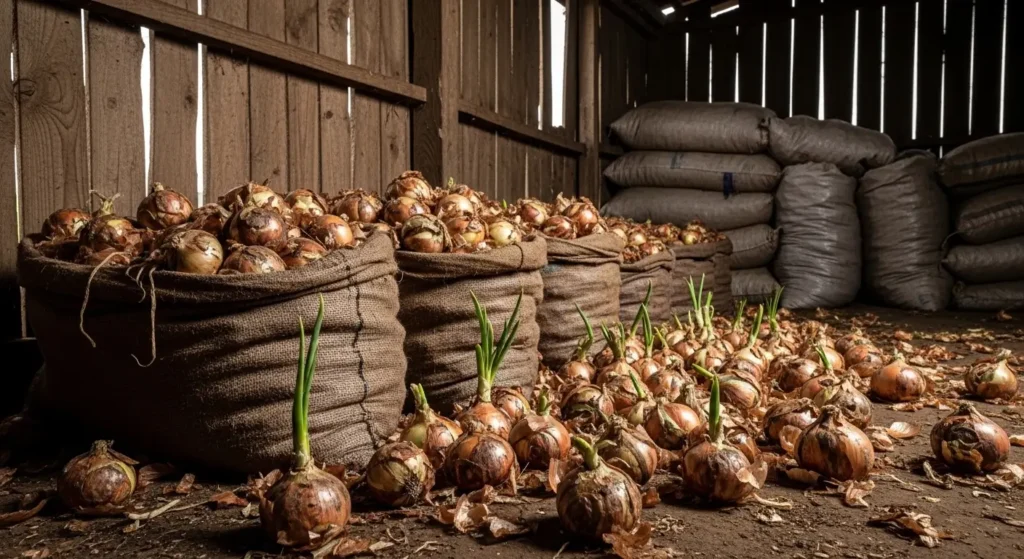
One of the most critical challenges in Africa’s onion value chain is storage. Onions require dry, ventilated, and temperature-stable conditions to remain viable over time. Without proper storage infrastructure, farmers are forced to sell immediately after harvest.
This creates a structural imbalance in market power. Buyers and traders gain pricing advantage because supply floods the market at once, driving prices downward.
In regions of Ethiopia, farmers often experience forced quick sales due to limited storage facilities. In Kenya, seasonal gluts regularly lead to sharp price crashes, particularly during peak harvest periods. Even where production is high, lack of storage means value is lost through timing rather than quantity.
In contrast, emerging improvements in storage systems in parts of Senegal are beginning to show how infrastructure can stabilize prices and reduce post-harvest losses.
The Hidden Economic Pressure to Sell Immediately
One of the most consistent realities I have observed across onion farming communities is the pressure to sell immediately after harvest.
This pressure is not only logistical it is financial. Farmers often depend on quick sales to repay input costs, settle debts or meet household needs. Without access to credit systems or storage facilities, they are locked into immediate market participation regardless of price conditions.
This creates a cycle where farmers have limited ability to negotiate. When everyone sells at the same time, prices fall. When prices fall, farmers lose value. And when farmers lose value, they are forced to depend even more on immediate sales in the next cycle.
This is not a market failure alone. It is a structural design issue within the value chain.
Country Contrasts: Different Systems, Same Pressure
Across Africa, post-harvest systems vary, but the underlying challenges remain similar.
In Ethiopia, many onion farmers face immediate post-harvest sales due to limited access to structured storage and market stabilization mechanisms. This leads to compressed selling periods and reduced bargaining power.
In Kenya, seasonal production cycles often result in market saturation, where large volumes of onions enter the market at once, causing sharp price declines that affect farmer income.
In Senegal, there are early signs of improvement, with investments in storage infrastructure and market coordination helping to reduce some of the volatility experienced in other regions. However, these systems are still developing and have not yet fully stabilized national production cycles.
Despite these differences, the central issue remains consistent: post-harvest systems are not yet strong enough to protect value created at the production stage.
Post-Harvest Losses: The Silent Drain on Africa’s Agriculture
Post-harvest loss is one of the most significant but under-discussed challenges in Africa’s agricultural economy. In onions specifically, losses occur through spoilage, physical damage, premature selling and price collapse.
These losses do not only affect farmers. They affect entire value chains, including traders, processors and consumers, by introducing instability into supply systems.
What makes post-harvest loss particularly important is that it represents lost value that has already been created. The crop has been grown, harvested and transported, yet much of its potential economic return is never realized.
Experience of Loss at Farm Level
From a field perspective, post-harvest loss is not abstract. It is visible in piles of onions that cannot be stored, in rushed sales at low prices and in transport systems that lack proper handling infrastructure.
Farmers experience this stage not as a technical issue, but as a financial shock that arrives immediately after harvest.
Where Value Disappears
The onion value chain in Africa demonstrates a critical structural pattern: production capacity is increasing, but value retention remains weak.
This means Africa is not only a production system it is a leakage system at post-harvest stage.
Why Post-Harvest Systems Determine Market Value
Post-harvest infrastructure determines whether agricultural value is preserved or lost. Storage, grading and timing systems directly influence price stability and market efficiency.
Without these systems, even high production volumes fail to translate into sustained economic returns for farmers.
Field Reality of Loss
In my reporting across agricultural systems in Africa, I have found that post-harvest stages often determine the actual income farmers receive, more than yield itself.
A successful harvest does not guarantee success in income. In many cases, it is the post-harvest stage that determines whether farming becomes profitable or loss-making.
The Real Crisis Begins After Harvest
The onion value chain in Africa is often framed as a production challenge. But the most severe losses occur after production has already succeeded.
Harvest is not the end of the agricultural journey. It is the beginning of a fragile economic phase where timing, infrastructure, and market structure determine whether value is preserved or destroyed.
Until post-harvest systems are strengthened, Africa will continue to produce onions efficiently, but lose significant value after harvest.
The real crisis in the onion economy does not begin in the soil. It begins after the harvest is done.
About the Author
Jackline Mauta is a Kenyan journalist and narrative strategist specializing in agriculture, food systems, and value chains across Africa. Through her work at Nexus PR Africa, she translates complex agricultural systems into structured, insight-driven narratives that inform policy, investment and food system transformation.