

Drones, Data and Dirt:
On the morning of February 10, 2026, scientists, engineers and government officials gathered at the Kenya Agricultural and Livestock Research Organisation headquarters in Nairobi. What they launched that day did not make front pages outside the continent. But for the five million smallholder farmers who farm 75 percent of Kenya’s arable land it should have.
The Crop Measurement and Evaluation Initiative CroME is Kenya’s most ambitious agricultural intelligence programme to date. Built by the Kenya Space Agency in partnership with the Ministry of Agriculture, Microsoft AI for Good Lab and NASA Harvest, it uses satellite Earth observation data and AI-driven geospatial models to do something that has never been done at national scale in Kenya before: map every crop, define every field boundary, monitor crop growth in real time and forecast yields before the harvest arrives.
Precision agriculture Kenya 2026 is not a pilot programme in a research centre. It is arriving on the farm. And the farmers building it are Kenyan.
What Precision Agriculture Kenya 2026 Actually Means on the Ground
Precision agriculture is the practice of using data from satellites, drones, soil sensors and AI tools to make farm decisions field by field, sometimes metre by metre, rather than applying the same input uniformly across an entire holding. The same amount of fertiliser spread across a farm that has six different soil conditions is waste. The same irrigation schedule applied to a field where one corner holds moisture and another drains fast is inefficiency. Precision agriculture eliminates both.
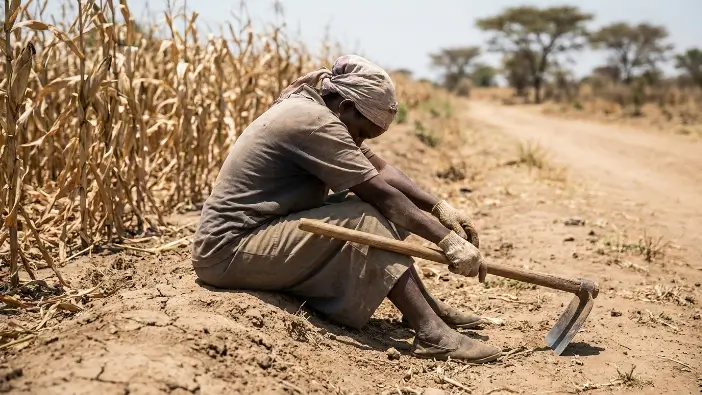
Kenya’s smallholder farming reality makes this more urgent than anywhere. The average smallholder farm in Kenya is less than half a hectare. Inputs are expensive. Margins are thin. A wrong decision on fertiliser timing or irrigation scheduling does not just reduce yield it can eliminate the season entirely.
Satellite data from the Kenya Space Agency enables farmers to monitor soil humidity, spot nutrient gaps and pinpoint pests with accuracy cutting water and fertiliser waste by up to 30 percent. That 30 percent is not an abstraction. On a smallholder farm where input costs consume a significant portion of household income, 30 percent efficiency gain is the difference between profit and debt.
Ambassador Philip Thigo, Kenya’s Special Envoy on Technology, said the CroME initiative positions Kenya at the forefront of digital agriculture on the continent. That is not diplomatic language. It is a technically accurate statement about what Kenya has now built.
Follow the Data From Soil Sensor to Satellite to Smallholder Decision
Follow the data from a farm in western Kenya to a decision made by a smallholder farmer and you find a system that is more sophisticated than most people realise and more accessible than most people expect.
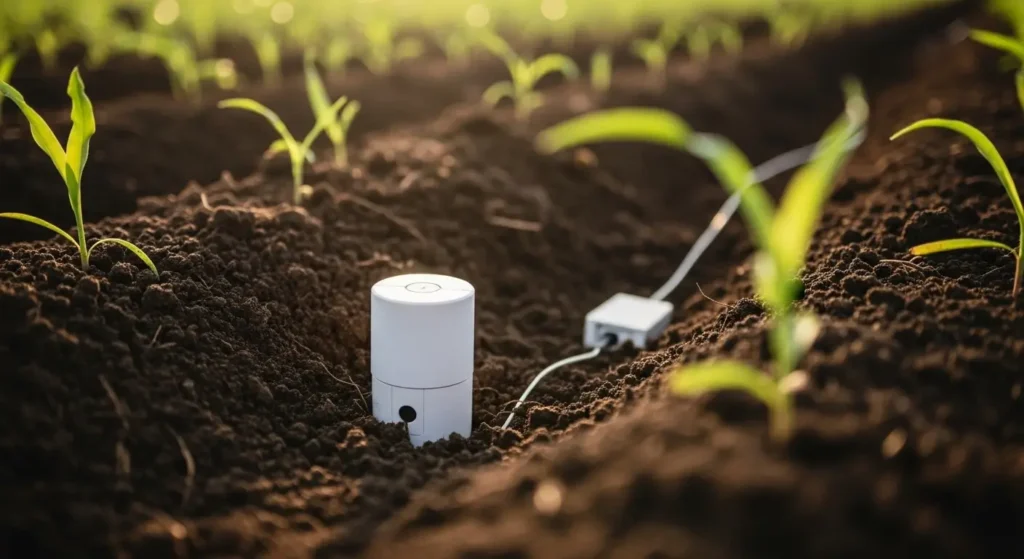
The soil sensor goes in the ground first. Synnefa a Kenyan company founded in 2013 produces the FarmShield device, which measures soil moisture, nitrogen levels, temperature and light intensity continuously. That data travels via satellite transceiver using the Iridium satellite network for farms beyond cellular range to a cloud platform called FarmCloud. FarmCloud processes it, predicts the optimum harvest time and projected yield, and delivers advice back to the farmer through a mobile interface. For a smallholder who works in Nairobi and manages their farm remotely which describes a significant portion of Synnefa’s more than 8,700 active farmers this is the difference between guessing and knowing.
Above the soil sensor, the drone arrives. In western Kenya, startups including Kipkebe have piloted drone spraying on tea estates halving both application time and costs compared to manual methods. The Ministry of Agriculture is rolling out drones nationally to scan soil health in real time, enabling targeted sprays that detect outbreaks early and protect yields before damage spreads.
Above the drone, the satellite watches everything. Kenya’s own Taifa-1 satellite launched via SpaceX Falcon 9 in 2023 monitors crop health and compares yields across the country season by season. The CroME initiative layers Microsoft AI and NASA Harvest’s earth observation tools on top of that national satellite data to produce cropland maps, crop type identification and yield forecasts that feed into decisions made by farmers, insurers, agribusinesses and government agencies simultaneously.
Three layers. Soil. Sky. Space. All feeding one decision. What to plant. When to irrigate. Where the pest outbreak is forming before it arrives. What yield to expect and whether to sell forward.
Precision Agriculture Kenya 2026 : What Is Being Built and by Whom
The most important fact about precision agriculture Kenya 2026 is who is building it.
CroME was not designed in Washington or Brussels and delivered to Nairobi. It was launched at KALRO Kenya’s own agricultural research institution by the Kenya Space Agency, in partnership with international institutions that are supporting Kenyan-led infrastructure. The distinction matters. Kenya is not receiving precision agriculture. Kenya is building it.
Synnefa is a Kenyan company. Its FarmShield device was designed for Kenyan farming conditions the unreliable cellular coverage, the remote farm locations, the smallholder scale that makes expensive Western precision agriculture equipment irrelevant. Synnefa’s farmers have reported a 30 percent increase in production compared to yields before they started using the devices. That outcome was produced by Kenyan technology, on Kenyan farms, solving Kenyan problems.
The KijaniSpace Project funded under the EU’s Horizon Europe programme and focused on the Lake Victoria Basin brings together 13 organisations including the Kenyan Marine and Fisheries Research Institute. African partners in this project are not receiving satellite data. They are being trained to develop their own minimum viable products that use satellite data and IoT to solve agricultural challenges specific to the region.
India’s $250 million line of credit routed via EXIM Bank announced for hand tractors and smart irrigation in Kenya adds the mechanisation layer to this digital infrastructure. Kenya’s agriculture is currently powered by 30 percent motorised equipment against a Vision 2030 target of 50 percent. That gap is closing with a capital line that is specifically designed to accelerate it.
This is not one initiative. It is a stack of interlocking investments Kenyan, continental and international building toward the same outcome: a Kenyan smallholder farmer who farms with data the way a commercial operation in the Netherlands does.
What Precision Agriculture Kenya 2026 Has Not Yet Solved
The technology is moving faster than the access.
AI chatbots providing tailored advice on fertilisers and pests via mobile are reaching farmers who have smartphones and connectivity. The five million Kenyan smallholders who farm 75 percent of Kenya’s arable land do not all have both. Rural internet connectivity remains a structural gap. Digital literacy the ability to interpret sensor data and act on it is not uniformly distributed. High upfront costs are sidelining youth who want to farm with precision tools but cannot afford the hardware.
The gender gap is the sharpest version of this access problem. Pamela Pali, a senior scientist at the African Plant Nutrition Institute in Kenya, has been direct about it: making precision agriculture a reality in Africa requires addressing gender equality among farmers first. Women farmers face barriers to access and use of resources, limited information on agricultural production and restricted decision-making roles in both traditional and precision farming. A satellite that maps every field boundary in Kenya does not automatically reach the woman farming one of those fields if the extension service, the advisory platform and the credit line attached to the technology were not designed with her access in mind.
The CroME initiative will support early warning systems during disasters and detect crop damage. But an early warning system is only useful if the farmer receiving the warning has the resources to respond. Drought warning without drought financing is information that arrives too late.
The Precision Agriculture Kenya 2026 Agenda What Comes Next
Kenya’s Ambassador Philip Thigo said CroME positions Kenya at the forefront of digital agriculture on the continent. The infrastructure to support that claim is real. The Kenya Space Agency. KALRO. Synnefa. DigiFarm. Kipkebe. Taifa-1. CroME. A $250 million mechanisation credit line. An EU-funded satellite data programme in the Lake Victoria Basin. A national drone deployment by the Ministry of Agriculture.
What the next phase requires is not more technology. It is the extension infrastructure that connects the technology to the farmer who needs it most. The woman in Kisumu with a half-hectare plot who is managing soil degradation and erratic rains and has not yet been reached by any of the platforms described in this article. The youth in Nakuru who can build a drone but cannot access the credit to start a drone service business.
Precision agriculture Kenya 2026 has built the tools. The question now is whether the tools reach the people who need them not just the farmers who already have smartphones, connectivity, and access to credit.
That is the work that follows the technology. And it is work that Kenya’s institutions, its innovators and its extension systems are now positioned to do.
ABOUT AUTHOR
Jackline Mauta is a Food Systems & Agribusiness Communications Specialist, Journalist, Media & PR professional and Corporate MC with a background in broadcast journalism and public relations. She specializes in documenting and communicating Africa’s food systems and agribusiness sector through articles, media briefs, documentaries and digital storytelling. Her work focuses on translating complex agricultural, market and policy issues into clear narratives that highlight the people, innovations and opportunities shaping the food value chain. Jackline also leads strategic communications and marketing initiatives, helping organizations strengthen their visibility, brand positioning and engagement within the agribusiness ecosystem.