

Where the Day Begins Before the Market Exists
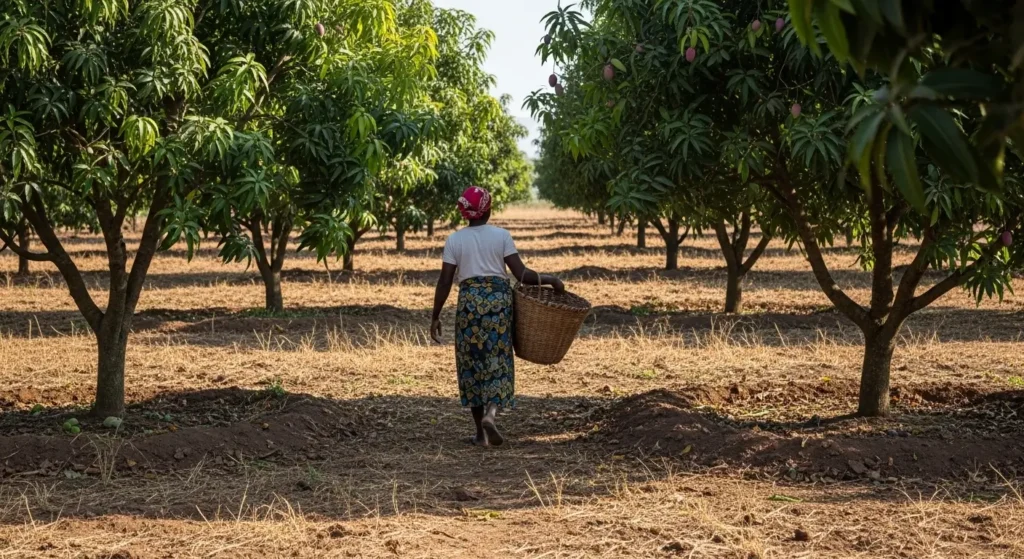
At first light in Makueni County, before the heat begins its slow, relentless climb, Mary Kavindu steps into her orchard. The ground is still cool beneath her feet, the air carrying a softness that will not last long. Around her, mango trees stretch in uneven rows, their branches heavy with fruit that signals both promise and uncertainty.
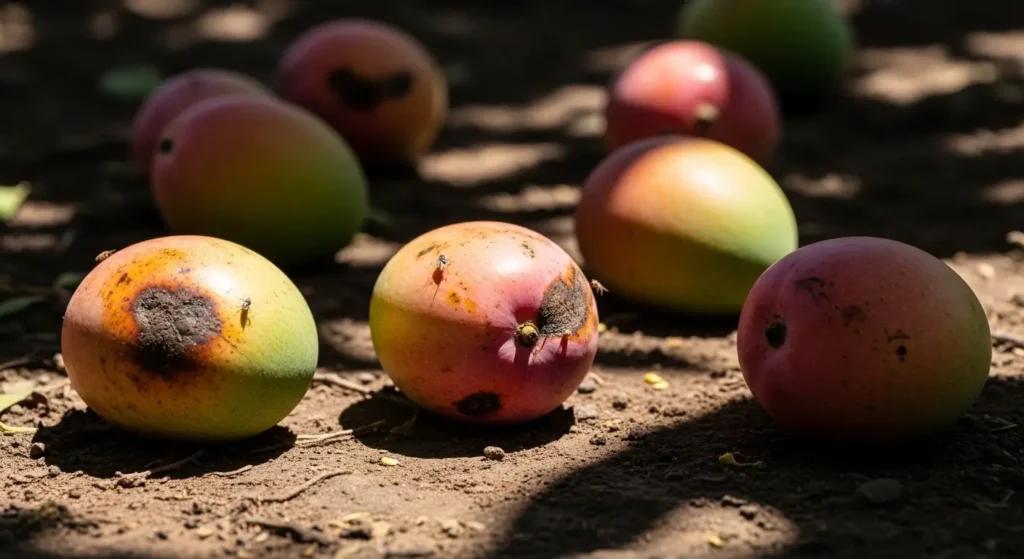
She moves quietly, almost deliberately, scanning the ground before reaching for what the night has already released. A ripe mango lies half-covered in dust. She bends, picks it up and turns it slightly in her hand, inspecting its skin before placing it into a woven basket she carries at her side.
There is rhythm in this work, but there is also memory.
There was a time when mornings like this carried a quiet tension. When the ripeness of fruit was not a moment of satisfaction, but the beginning of a race against time. The question was never whether the mangoes would be ready. It was whether anyone would come for them before they spoiled.
For years, much of what Mary harvested never made it beyond the boundaries of her farm.
The Invisible Barriers Within Kenya’s Agricultural Backbone
Smallholder farmers form the backbone of Kenya’s agricultural system, producing the majority of the country’s food and sustaining rural economies that stretch across counties and climates. Yet for many of these farmers, production has never been the central problem.
The deeper challenge has always been what happens after.
In regions like Makueni County, where mango farming is both a livelihood and a regional identity, the gap between production and market access has historically defined the limits of what farming could achieve. Farmers worked in isolation, selling individually to brokers whose arrival was unpredictable and whose pricing power was absolute.
Even in seasons of abundance, this structure turned opportunity into loss.
Mangoes would ripen all at once, overwhelming local demand. Without cold storage, without coordinated transport, without access to structured buyers, farmers were forced into decisions that favored immediacy over value. Selling quickly at low prices often felt safer than waiting for a better offer that might never come.
And so, across farms like Mary’s, a quiet pattern repeated itself.
Fruit would fall.
Some would be sold.
Much would be lost.
Understanding the Value Chain Beyond the Farm Gate
To understand why this pattern persisted for so long, it is necessary to step back and look at the broader system within which farmers operate.
Agriculture does not end at harvest. It extends through a network of actors and processes that collectively determine whether produce becomes profit or waste. For mangoes, that journey moves from farmer to aggregator, from collection point to processor, from exporter to market.
Each step carries its own requirements, its own expectations of quality, volume and consistency.
For years, the weakest point in this chain lay at the very beginning.
Farmers, working individually, could not meet the scale or uniformity required by processors and exporters. Without aggregation, even high-quality produce struggled to find a pathway into formal markets. Without visibility, farmers remained disconnected from buyers who might have been willing to engage under different conditions.
The chain existed, but it did not function as a system.
It functioned as fragments.
The Slow Emergence of Structure and Coordination
Change did not arrive in a single moment. It unfolded gradually, through a series of interventions that began to reshape how farmers engaged with the market.
Aggregation centers were introduced, creating physical points where produce could be collected, sorted and prepared for onward movement. Farmers were encouraged to organize into groups, shifting from individual actors to participants in a collective system.
Training followed, focusing not only on production techniques but on quality standards, harvesting practices, and timing. The language of markets once distant and abstract began to take on practical meaning at the local level.
These changes, while technical in appearance, carried deeper implications.
They began to reduce the distance between farmers and buyers.
They introduced a level of predictability into a system that had long been defined by uncertainty.
And perhaps most importantly, they created the conditions for something else to emerge.
When Farmers Move from Invisible to Visible
Alongside the development of physical and organizational structures, another transformation began to take shape one that was less visible, but no less significant.
Farmers started to be seen.
Their work was documented through photographs, interviews and field narratives that captured not just what they produced, but how they lived and worked within their environments. What had once been anonymous output became connected to identifiable people, places and practices.
This shift in visibility altered the dynamics of the value chain in subtle but important ways.
For buyers, it introduced a new layer of trust. Knowing where produce comes from and who is responsible for it reduces uncertainty. It transforms transactions from abstract exchanges into relationships grounded in understanding.
For development partners and funders, visibility made impact tangible. Numbers and metrics could now be linked to real lives, making it easier to assess, communicate and support interventions.
And for farmers themselves, the change was more personal.
It was about recognition.
A Different Kind of Market Relationship Takes Shape
Mary remembers the first time her mangoes were delivered through an organized collection system. The process felt unfamiliar at first structured, coordinated, and guided by standards that required attention to detail.
But it also felt different in another way.
Before, she had waited.
Now, there was a sense that the system was waiting for her.
Buyers were no longer distant figures who appeared unpredictably at the roadside. They were connected to a chain that extended back to her farm, anticipating supply, setting expectations and creating a pathway that her produce could follow.
The uncertainty did not disappear entirely. Agriculture rarely allows for that. Weather patterns shift. Markets fluctuate. Systems require maintenance and trust to function effectively.
But the nature of uncertainty changed.
It became something that could be managed, rather than something that defined every decision.
The Subtle but Powerful Role of Story in Agricultural Systems
In discussions about agricultural transformation, attention often focuses on infrastructure, inputs, and technology. These elements are undeniably important. They shape productivity, efficiency and resilience in measurable ways.
But there is another layer to these systems one that operates through perception, understanding and connection.
This is where storytelling enters.
Stories do not replace data. They complement it. They provide context where numbers alone might fall short, allowing different actors within the value chain to see how their roles intersect with the lives of others.
In Makueni, storytelling has begun to function as a bridge.
It connects farmers to markets by building narratives that buyers can trust. It translates local experiences into forms that can travel across institutions, informing decisions made far from the fields where those experiences originate.
It also reshapes how farmers see themselves.
When their work is documented and shared, it affirms their place within a broader system. It reinforces the idea that their contributions are not isolated, but integral to something larger.
Market Access as the Defining Line Between Survival and Growth
For many smallholder farmers, the difference between subsistence and growth lies not in how much they produce, but in where that production can go.
Market access is not simply about selling. It is about entering a system where value is recognized and rewarded consistently.
In the case of Makueni’s mango farmers, improvements in aggregation, coordination, and visibility have begun to open pathways that were previously inaccessible. Processors can now source with greater confidence. Exporters can engage with supply that meets their requirements more reliably.
For farmers like Mary, this translates into something both simple and profound.
Her mangoes have somewhere to go.
They are no longer confined to the limits of local demand or the unpredictability of informal trade. They move within a system that extends beyond her immediate environment, connecting her work to markets that value it differently.
What Makueni Reveals About Africa’s Food Systems
The changes unfolding in Makueni County are not unique to this region alone. They reflect patterns and possibilities that exist across much of Africa’s agricultural landscape.
In many countries, smallholder farmers operate within systems that are rich in production but constrained by weak connections. Value chains exist, but they do not always function in ways that allow all participants to benefit equitably.
The opportunity lies in strengthening these connections.
It lies in building systems that are not only efficient, but inclusive.
And it lies in ensuring that the people at the center of these systems are visible — not just as producers, but as participants whose roles are understood and valued.
Returning to the Farm, Where Change Is Felt Most Clearly
By mid-morning, the heat in Makueni has settled in. The softness of dawn has given way to a sharper light that defines the contours of the land more clearly.
Mary pauses for a moment, standing beneath the shade of a tree as she looks out across her farm.
The work itself has not changed dramatically. The routines remain familiar. The tasks, repetitive in their own way, continue to shape her days.
But the context within which that work exists has shifted.
The distance between effort and reward has narrowed.
The uncertainty that once defined each harvest has softened into something more manageable.
And the sense of isolation that marked earlier years has been replaced, at least in part, by connection.
The Future of Agriculture Lies in Connection, Not Just Production
Across Africa, conversations about food systems often focus on increasing production, improving inputs, and adopting new technologies. These are critical elements, particularly in the face of climate change and growing populations.
But production alone is not enough.
Without systems that connect farmers to markets, without structures that support coordination and trust, increased production can simply lead to increased loss.
The story unfolding in Makueni suggests a different approach.
One that recognizes the importance of relationships within the value chain.
One that understands that visibility, coordination, and narrative are not peripheral concerns, but central components of a functioning system.
Because in the end, agriculture is not only about what is grown.
It is about how what is grown moves through systems, through markets, and through the stories that carry it beyond the farm.
At Nexus PR Africa, this intersection between agriculture and narrative is where the work begins. By documenting realities within value chains, shaping stories that travel, and positioning voices that might otherwise remain unheard, the aim is not simply to communicate what is happening.
It is to ensure that what is happening can influence what comes next.