

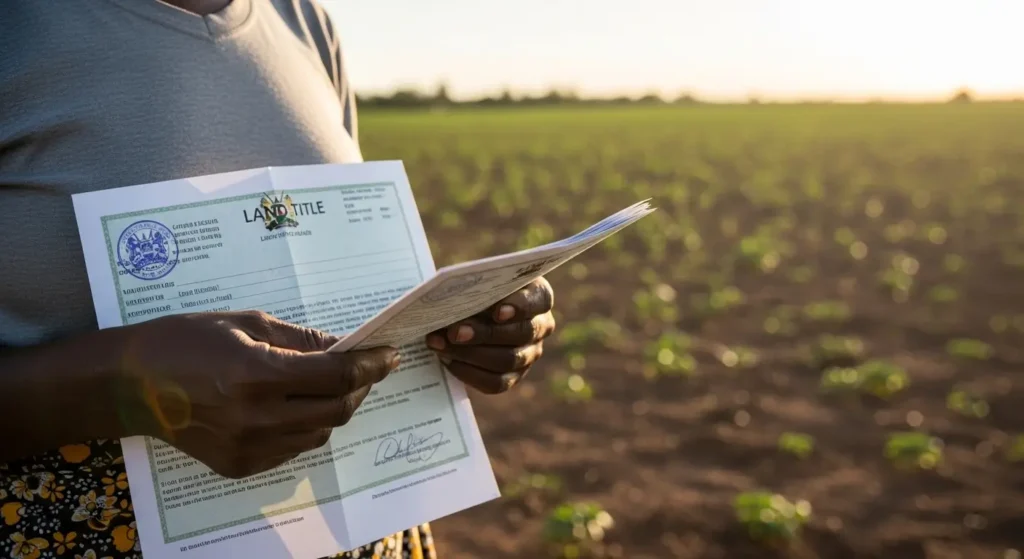
Women farmers across Africa land the hardest reality in agriculture every single morning they do most of the work and own almost none of what they work on.
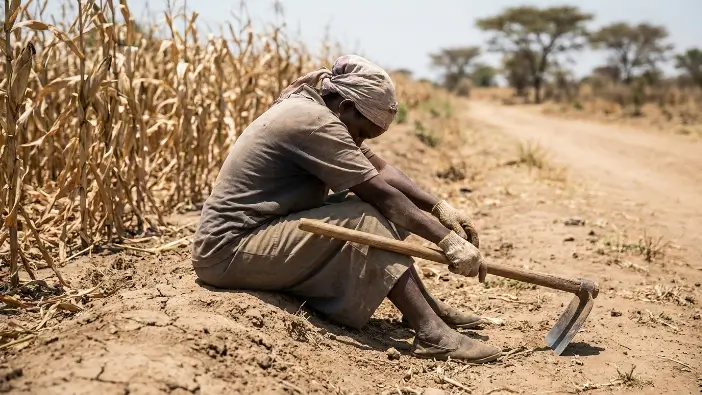
Think about the woman who was already on her farm before you finished your morning cup of tea today. She did not need a weather app to know rain was coming. She read it in the sky the evening before that particular shade of grey that settles over the hills, the way the wind shifts direction just before the clouds move in. She knows her soil the way you know your own handwriting. She knows which corner of her plot drains badly after heavy rain, which row catches the best light in the dry months and exactly how many weeks she can stretch the last harvest if the next season disappoints.
She is not exceptional. She is everywhere in Murang’a and Meru and Kisumu in the fields of Malawi, the smallholder plots of Nigeria, the highlands of Ethiopia. She is, by every honest measure, one of the most essential workers on this continent.
And the land she is farming almost certainly does not belong to her.
That gap between the woman who does the work and the name on the title deed sits at the centre of one of the most urgent conversations in African agriculture in 2026. Women produce approximately 70 percent of Africa’s food. In Kenya, women contribute close to 80 percent of agricultural labour. Yet according to the Kenya Land Alliance, women hold only 1 percent of all land titles in their own names, and just 5 to 6 percent jointly. The 2022 Kenya Demographic and Health Survey confirmed that 75 percent of Kenyan women aged 15 to 49 owned no agricultural land at all. In 2014, that figure was 61 percent.
It is moving in the wrong direction.
This is the year the United Nations has designated as the International Year of the Woman Farmer. Declarations are being made. Summits are being held. Awards are being announced. But if the woman farming at 5am this morning does not come out of 2026 with better legal standing to the land she works, then this year will have been a very well-attended missed opportunity.
Women Farmers in Africa and Land Rights: The Honest Answer
This is one of the most searched questions on this topic. Most of the answers people find are careful and hedged. This one will not be.
The reason women farmers across Africa land in a system that excludes them from ownership is not an accident of history that nobody got around to fixing. It is the result of systems legal, customary, cultural and institutional that were built to keep land in male hands and have been remarkably effective at doing exactly that.
In Kenya, over 65 percent of land is governed by customary law. Under most of those frameworks, a woman accesses land through her husband, her father or her sons. When those men move to cities as millions have ,she tends the land alone with no legal claim to the asset that makes her livelihood possible. She cannot use it as collateral for a loan. She cannot pass it to her own daughters when she dies. In Kilifi and Kakamega counties, customary law attributes land titles solely to a woman’s husband or his family. Any improvements she makes to that land belong to him.
The barriers stack on top of each other with a logic that is almost elegant in its brutality. No land title means no collateral. No collateral means no bank loan. No bank loan means no quality seeds, no fertiliser, no irrigation equipment. Without those inputs, yields stay low. With low yields, income stays low. With low income, there is no financial or political power to push for the legal reforms that might eventually break the cycle.
And then there is the extension officer who arrives at the farm and asks to speak to the man of the house even when the man of the house has not been seen since February, and the woman standing in front of him has been managing five acres, two harvests and three sets of school fees entirely alone.
Kenya’s constitution guarantees women equal land rights under Articles 40 and 60(f). The customary systems governing most of the country’s agricultural land do not honour that guarantee. In practice, the customary systems win. Between 2013 and 2017, the Kenyan government issued approximately 3.2 million land titles. Women received 103,043 of them 10.3 percent of titles, but only 1.62 percent of the total land area titled. Men received 97.76 percent of the land by area. Those numbers come from the Kenya Land Alliance’s own analysis, not from advocacy projections.
This is not a women’s problem. It is a food systems problem. It is a national economic problem. And it is a problem with a known solution that the continent has not yet had the political will to implement at scale.
What the Land Gap Costs Women Farmers Across Africa
The FAO has calculated that if women farmers had the same access to productive resources as men land, credit, seeds, extension services their yields would rise by 20 to 30 percent. That single change could reduce the number of hungry people in the world by 100 to 150 million. Not through new technology. Not through importing more food. Simply by removing the artificial walls currently stopping women farmers across Africa, land included, from farming as productively as they are fully capable of farming.
In Kenya, where 3.5 million people face food insecurity, that scale of improvement is not a statistic. It is hundreds of thousands of people fed every season.
Beyond the yields, there is the question of what women do with agricultural income when they control it. Research across multiple countries consistently shows that when women manage household earnings, a higher share flows back into children’s nutrition, school fees and household health. It compounds across generations in ways that male-controlled income frequently does not. The land gap does not just cost women. It costs their children, their communities and the national economy a return on agricultural investment that is left on the table every single season.
One more number worth sitting with: in Embu, Laikipia, Nakuru and Murang’a counties where women hold land documents at rates between 38 and 61 percent something measurably different is happening economically compared to counties like Kisumu, Siaya and Homa Bay where that figure falls below 5 percent. The correlation between women’s land access and community economic outcomes is not theoretical. It is visible on a county-by-county map of Kenya right now. You can read the full Kenya Land Alliance analysis at kenyalandalliance.or.ke.
Women Farmers Africa Land Rights: What 2026 Must Deliver
The United Nations declared 2026 the International Year of the Woman Farmer. In February, at the 39th African Union Summit in Addis Ababa, the Economic Commission for Africa made commitments that go further than the usual language of summits.
The ECA proposed country-level roadmaps and a scorecard a mechanism holding individual governments accountable by tracking measurable progress on closing gender gaps in agricultural productivity, asset ownership and leadership. Not a general aspiration. A named tool with numbers attached to specific countries. What gets measured is what gets done, and what gets done is the only thing that matters to the woman who still does not own the land she works.
The African Development Bank’s AFAWA initiative — Affirmative Finance Action for Women in Africa — is working directly on the financing side of the same problem. It targets the $49 billion access-to-finance gap facing African women entrepreneurs by partnering with financial institutions to de-risk lending to women, rather than expecting women to navigate banking systems that were never built for them. In Côte d’Ivoire, one AFAWA supported cooperative project has positively impacted more than 21,300 women in agricultural value chains. A cooperative chairperson involved in that programme said it plainly: her community already knew how to grow the food. What they needed was to learn how to finance growing significantly more of it.
That sentence should be on the wall of every development finance institution operating on this continent.
Then there are the WAYA Awards. AGRA’s Women Agripreneurs of the Year Awards part of its VALUE4HER programme are open for applications right now. The deadline is 8 May 2026. Winners receive grants of up to USD 300,000 to scale their enterprises. The awards ceremony takes place at the Africa Food Systems Forum in Kigali, Rwanda in September. Last year, nearly 2,000 women from across the continent applied from Benin, Burkina Faso, the DRC, Ghana, Kenya, Malawi, Nigeria, South Africa, Tanzania and Uganda. Apply directly at the AGRA VALUE4HER page.
If you are running a women-led agribusiness anywhere on this continent — the window is open right now. Do not let 8 May pass without your name in it.
The Women Who Are Already Building Without Waiting
Here is what strikes me most when I look at what women farmers across Africa land-grabbing, drought and exclusion have not been able to stop.
The women closest to this problem are not waiting for governments to act. They never have been.
In Laikipia North, a women’s group was allocated a few acres of degraded, arid land ground that previous owners had written off as unproductive. The women installed water harvesting structures, restored the soil, planted aloe vera and established beehives. Before the project, the community managed around 11 meals per month. Within a short period, they were eating every day. Same land. Different hands. Completely different outcome.
In Central Kenya, something quieter and equally powerful is happening. In Embu, Laikipia, Nakuru and Murang’a, women are increasingly buying land not inheriting it, not accessing it through male relatives, but purchasing it outright through SACCOs, microfinance loans and business income accumulated over years.
The Women Enterprise Fund, launched in 2007 and women-only SACCOs have been central to this shift, providing low-interest loans and business training that translate directly into land purchases. The title deeds going into women’s names in these counties are not gifts from a reformed system. They are the product of women who organised, saved and outmaneuvered a system designed to exclude them.
These are not stories of exception. They are evidence of what becomes possible when women have access to income, financial products designed for them and legal frameworks that function in their favour.
Three Things That Would Actually Change This
The policy conversations around women’s land rights in Africa have been running for thirty years. Progress has been slow not because nobody knows what to do. It is because the things that need doing are politically difficult in ways that make institutions prefer declarations to decisions.
Here is what would actually work.
Make constitutional rights function at community level. Kenya’s constitution is not the problem. The customary governance systems operating beneath it are. Closing that gap requires community land documentation, accessible legal aid, and dispute resolution processes that rural women can actually afford to use. Ethiopia’s joint land registration system requiring both partners’ names and photographs on certificates demonstrably increased women’s agricultural investment and tenure security. Kenya has the legal architecture. What it needs is the implementation.
Build financial products that begin from women’s actual lives. The $49 billion financing gap facing African women entrepreneurs is not evidence that women are bad credit risks. It is evidence that most financial products were designed around male asset profiles. The AFAWA model proves de-risking works. It should be the industry standard for agricultural finance on this continent not the exception that requires a development bank to make it happen.
Count women in the data that drives decisions. Agricultural databases, land registries and the digital advisory tools shaping policy are effectively blind to women who farm land registered in a husband’s name. Making women visible requires deliberate choices: recording agricultural activity in women’s own names, disaggregating all agricultural statistics by gender, and designing digital tools around women’s connectivity realities rather than assuming male access as the default.
None of this requires new science. All of it requires political will.
The Year That Cannot Just Be a Year
December 2026 will arrive. The International Year of the Woman Farmer will end. The reports will be filed, the banners will come down, and the next themed year will be announced.
The woman who was on her farm before you finished your tea this morning will still be there.
The question that 2026 has to answer — with numbers, before that year ends — is whether the governments, institutions, and funders making declarations this month will take actions that outlast the calendar entry.
The ECA scorecard, the AFAWA partnerships, the WAYA grants — these are not symbolic. They are the architecture of change when they are sustained and scaled. But they only reach women farmers across Africa, land and all, if the political will behind them does not expire when the themed year does.
She has been farming without recognition, without title and without the resources her labour deserves for generations.
2026 is not the year to celebrate that contribution.
It is the year to back it — legally, financially and structurally.
ABOUT AUTHOR
Jackline Mauta is a Food Systems & Agribusiness Communications Specialist, Journalist, Media & PR professional and Corporate MC with a background in broadcast journalism and public relations. She specializes in documenting and communicating Africa’s food systems and agribusiness sector through articles, media briefs, documentaries and digital storytelling. Her work focuses on translating complex agricultural, market and policy issues into clear narratives that highlight the people, innovations and opportunities shaping the food value chain. Jackline also leads strategic communications and marketing initiatives, helping organizations strengthen their visibility, brand positioning and engagement within the agribusiness ecosystem.